
Ocean Freight Rates: Dalian-Oakland Up 16% as India-US East Coast Rates Fall 21%
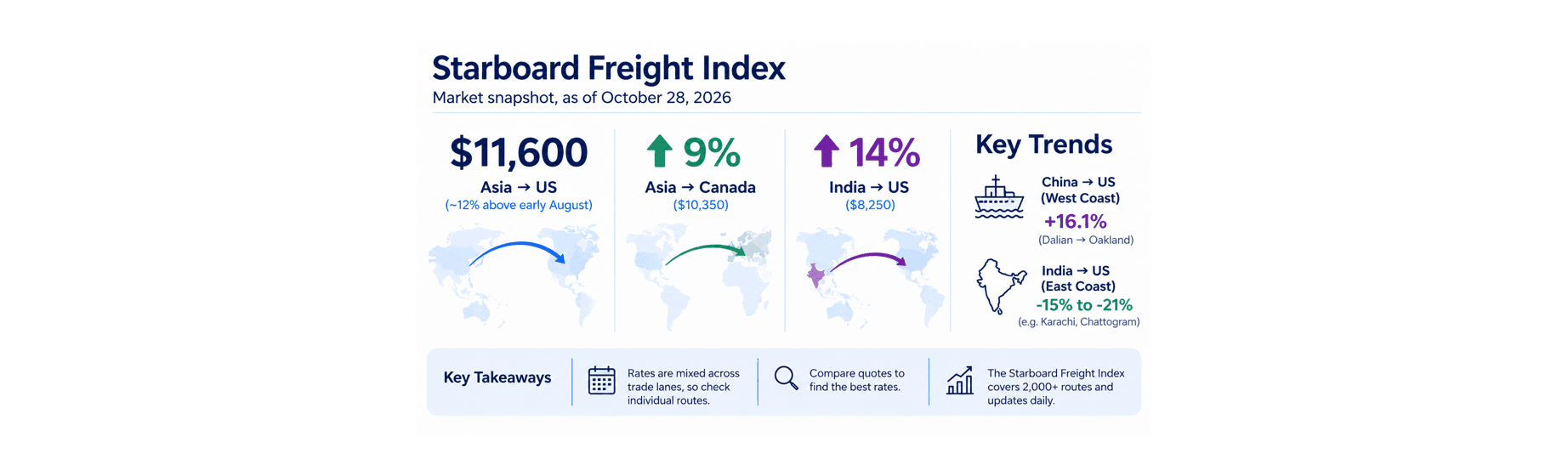
Ocean freight rates on major Asia-to-North America routes have been quite steady during the past week. However, analyzing the individual trade lanes reveals some major differences, with certain routes seeing increases while others experience notable declines.
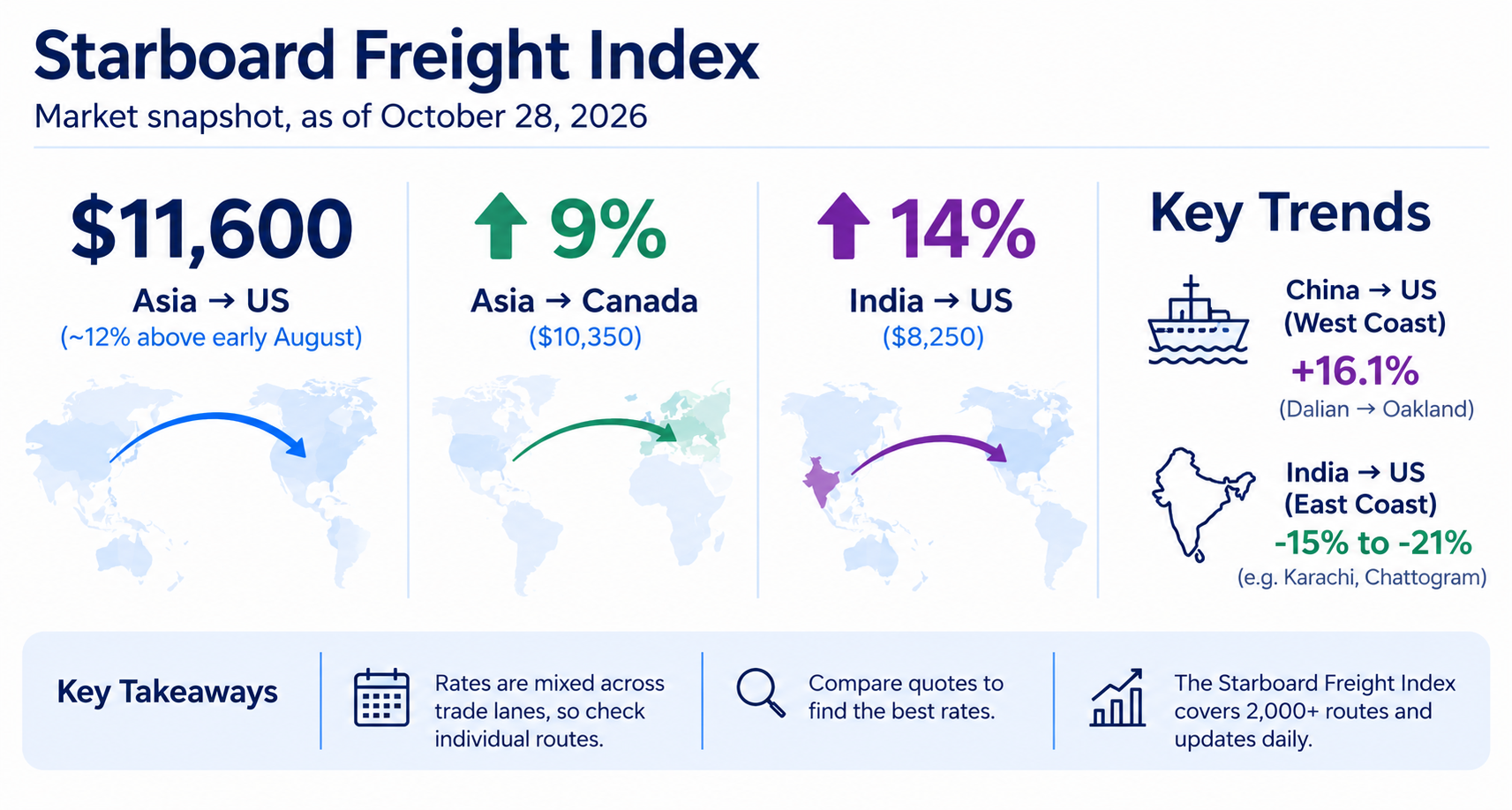
The Starboard Freight Index shows that Asia-to-US rates are holding at a median of $11,600, which is 12% above the early August levels. Meanwhile, Asia-to-Canada rates are at $10,350, while India-to-US rates are $8,250.
However, these numbers don't show the complete picture of current market dynamics. Dalian-to-Oakland rates are up 16% over the last 30 days, while several India-to-US East Coast routes have declined by 15-21%.
What's happening across individual routes?
Our data shows booking activity is increasing from the US to China, driven by the traditional peak season. India to US activity seems to be getting slower. This is a combination of tariffs and vessel capacity. Carriers are redeploying capacity elsewhere.
- China-to-US West Coast increases: The highest 30-day increase is on the Dalian-to-Oakland route with 16.1%, at the median of $8,300. Dalian-to-Houston also increased by 5%. Strong US import demand, limited vessel capacity, and port congestion in Asia are helping keep rates elevated on this route.
- India-to-US East Coast declines: The rates on Karachi-to-Charleston, Chattogram-to-New York, and Karachi-to-Savannah have all declined by about 20% over the last 30 days. Slower booking activity in October has led carriers to compete more aggressively for cargo, putting downward pressure on spot rates.
- Different trends across US destinations: While India-to-East Coast rates are decreasing, routes from Visakhapatnam and Chennai to the US West Coast have increased by approximately 4-7%. Differences in available vessel capacity and booking demand help explain why West Coast rates are rising while East Coast rates are falling.
These statistics demonstrate how misleading it can be to look at overall regional averages. Rates tend to differ based on the point of origin and destination, even within the same trade region.
What this implies for freight forwarders
With some lanes increasing in certain directions and decreasing in others, it is essential for freight forwarders to keep an eye on their trade routes.
Comparing quotes is especially vital in cases where rates are changing at different speeds. Checking multiple carrier offers can help identify competitive pricing and avoid quoting based on outdated market rates.
The Starboard Freight Index enables freight forwarders to benchmark ocean FCL rates on more than 2,000 trade routes and compare quotes with market medians. It's free to use and updated daily.