
← Back to blogIndustry News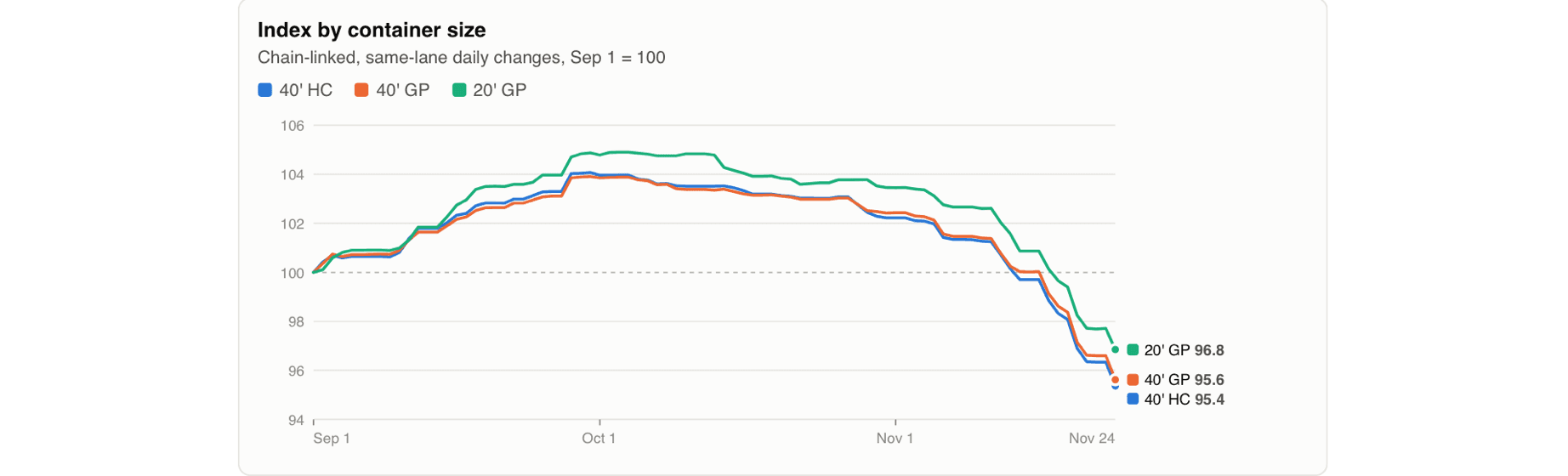
Transpacific Base Rates Break as Ocean Freight Posts Its Steepest Weekly Drop
November 24, 2026
Asia-to-North America ocean freight rates just had their sharpest week since September. Here is what the Starboard Freight Index shows as of November 24:
- Index down 3.5% in one week to 95.4 (September 1 = 100). That is the steepest weekly drop in the series.
- Down 7.5% over four weeks and 8.4% off the September 30 peak.
- 1,777 of 2,018 lanes fell. Only 61 rose.
- The $8,300 West Coast benchmark broke. Shanghai-to-Los Angeles went from $8,300 to $7,850. Ningbo-to-Los Angeles is $7,750, Ho Chi Minh City-to-Los Angeles $7,700.
- US East Coast is 7% below September 1. Shanghai-to-Savannah is $10,200, down 11% since September.
- India is the weakest origin. Indian Subcontinent rates are down 12% since September 1. Nhava Sheva-to-New York has gone from $10,400 to $6,800, a 27% drop.
- All three container sizes are now below where they started September.
Why rates are falling
This is not noise from a handful of lanes. The slide shows up in every origin and every destination the index covers.
- The peak-season lift has fully unwound. Rates climbed about 4% through September, held flat through October, then started easing in late October. This week the decline accelerated. Every US and Canadian destination region fell 3.2-4.6%, and China, Northeast Asia and Southeast Asia origins all fell 3.5-4.2%.
- Carriers lost the base-rate line they held for seven weeks. Main China-to-US West Coast lanes sat at about $8,300 from early October until November 17. This week they dropped $450-550 in one move, and Busan-to-Seattle and Shanghai-to-Vancouver followed to $7,800. Once a benchmark like that gives way, the lanes priced off it reprice quickly.
- India has been sliding for two months. South Asia origins peaked on September 30 and are now 18.7% below that peak, the deepest fall of any region. Slower bookings and carriers competing for cargo have been pushing this trade down since October.
- Some of the move is contracts rolling off. The index tracks contract and tariff rates in effect, measured over a trailing 14-day window. Month-end contracts expiring in late October and mid-November drop older, higher rates out of the window, which adds to the fall.
Where the opportunity is
Falling rates are only bad news for forwarders who keep quoting old ones. For everyone else, there is room to move.
- Cheaper buy rates mean sharper quotes. A forwarder quoting Shanghai-to-Los Angeles off last month's $8,300 is $450 above the market today. Requoting on current rates wins business without giving up margin.
- Not every lane has given back its gains. Canada is still 3% above its September 1 level at 103.0, Southeast Asia origins are 2% higher, and the US Gulf is almost flat. On those lanes, old rate sheets are not far off, and the margin is still there.
- The index is contract rates, not spot. It shows where filed rates stand, so it tells you what carriers have actually committed to, not what a single bid looked like this morning. That makes it a solid floor to negotiate from.
The Starboard Freight Index enables freight forwarders to benchmark ocean FCL rates on more than 2,000 trade routes and compare quotes with market medians. It's free to use and updated daily.